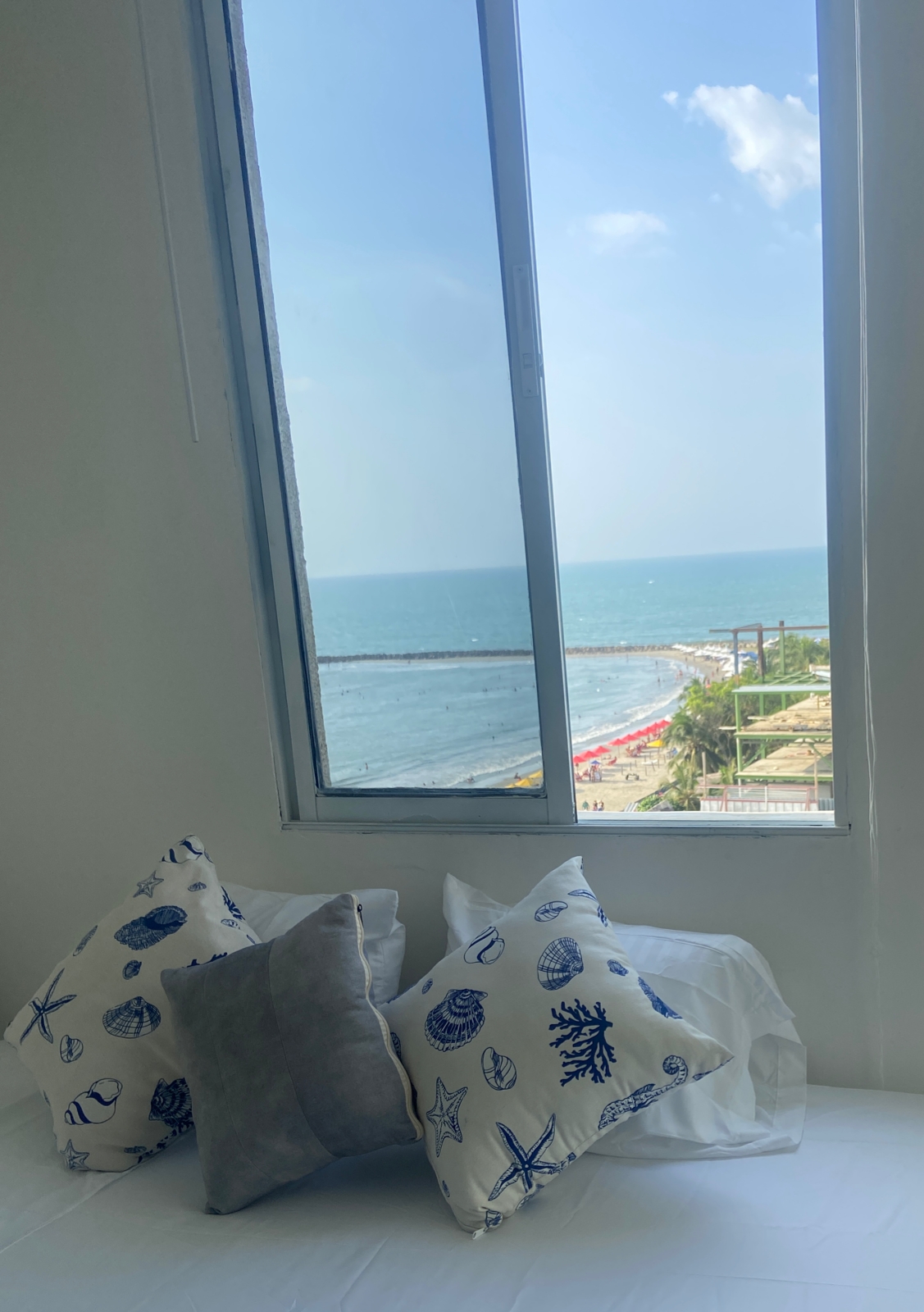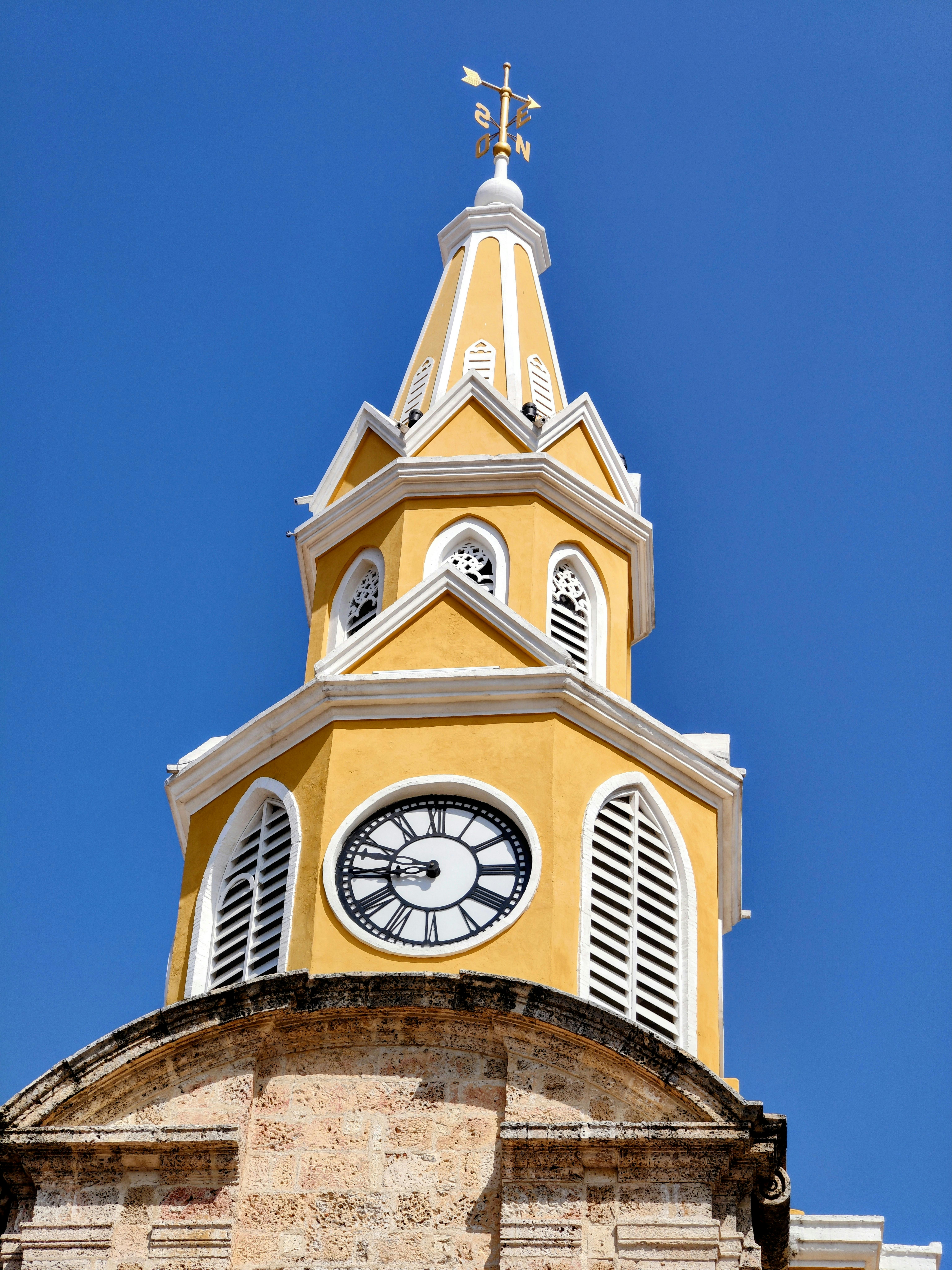
Cartagena has no cool season, only a wetter one. The temperature barely moves all year, so what you are really choosing between is rain, wind, crowds and price. Here is the full year, month by month.
When is the dry season in Cartagena?
December through March, and it is genuinely dry. According to Climates to Travel, January gets about 4 mm of rain across a single rainy day, February roughly 1 mm and no rain days at all, and March 2 mm. December is already tapering off at 35 mm over three days.
What does not change is the heat. Highs sit between 31 and 32 °C every month of the year and lows between 24 and 26 °C, with humidity of 78 to 83 %. The sea never drops below about 27 °C. There is no cool month in Cartagena, only a month with less water falling out of the sky.
That same dry season is also the brisas season: northeast trade winds blow hard from December into March. They are what keeps the sky clear, and also what churns up the water.
What is the rainy season actually like?
Less dramatic than it sounds. Rain in Cartagena typically arrives as short heavy downpours, often in the late afternoon or evening, rather than all-day drizzle. You get soaked for twenty minutes, drink a limonada de coco under an awning, and carry on.
October is the wettest month, with roughly 230 to 270 mm depending on which source you read. Even so, Climates to Travel counts about 16 rain days in October, which means around half the month stays dry.
From May to November the numbers run between 100 and 140 mm a month, apart from the October spike: May 115 mm over 10 days, June 100 mm over 12, July 110 mm over 10, August 125 mm over 13, September 135 mm over 14, November 140 mm over 11. April is the hinge month at just 25 mm over 3 days.
You will hear about the veranillo de San Juan, the break in the rains that starts around 24 June and stretches into July and August. It is a real regional phenomenon, but on the coast it shows up only as a mild dip in rainfall, not a dry month. Do not plan a trip around it.
Is there a hurricane risk in Cartagena?
Cartagena sits at about 10° north, on the southern rim of the Caribbean, well away from the main Atlantic storm track. There is no modern record of a hurricane making a direct landfall on Colombia's mainland coast.
That is not the same as zero risk. Systems passing to the north can still push swell and rain onto the coast. And the Colombian territory that is genuinely exposed is San Andrés and Providencia, about 700 km to the northwest: Providencia was devastated by Hurricane Iota in 2020. If the islands are on your itinerary between August and October, watch the forecast more closely than you would for Cartagena.
When is Cartagena cheapest?
September, October and the first half of November. These are the quietest weeks of the year and where your money goes furthest on flights and apartments. The trade-off is rain, not heat: October feels exactly like January.
Colombian high season comes in four blocks: mid-December to mid-January (by far the biggest), Semana Santa, mid-June to mid-August for school holidays, and puentes festivos, the Monday-shifted public holidays that land roughly every month and fill the city with domestic travellers for three days.
When is Cartagena most crowded?
Year-end, without question. In the 2025–26 season Cartagena's hotel occupancy hit 81.28 %, up from 76.98 % the year before, with over 1.3 million visitors, around 40 % more than the previous season. The first week of January 2026 came in at 78 % occupancy.
In practice you feel that on the walls at sunset, in the restaurant queues in Getsemaní, and in the rates. If you are travelling between 20 December and 10 January, book months ahead and accept that you will be sharing the ramparts.
We see the same pattern at 77Rentals every year: the Bocagrande and El Laguito apartments for year-end go from September onward, while in September and October longer stays are much better value. If your dates are flexible, that gap is the thing to use.
What events are on in Cartagena, and when?
- Fiestas de Independencia de Cartagena 2026: core programme approximately 8–15 November. The independence act is on 11 November, the Gran Desfile along Av. Santander on 12 November, and the Fiesta Naval on 13 November.
- Hay Festival Cartagena 2027: 28–31 January 2027, with tickets from November 2026.
- Carnaval de Barranquilla 2027: 6–9 February 2027, two hours up the coast.
- Semana Santa 2027: 21–28 March 2027. High season across Colombia.
- FICCI 66, the Cartagena International Film Festival: 6–11 April 2027.
- Christmas alumbrados: they happen every year, but the city sets dates and locations year by year and the 2026 programme is not out yet. Check with the Alcaldía closer to your trip.
Month-by-month summary
Rainfall and rain-day figures from Climates to Travel. The temperature is the same every month, so we are not repeating it.
- January · 4 mm, 1 day. Dry, windy, expensive and packed until about the 10th. Hay Festival at the end of the month.
- February · 1 mm, 0 days. The driest month of the year. Strong brisas and choppy sea. Barranquilla Carnaval nearby.
- March · 2 mm, 1 day. Still dry and windy, with fewer people than January. Watch for Semana Santa.
- April · 25 mm, 3 days. The winds ease and the rain starts to show up. A well-balanced month. FICCI.
- May · 115 mm, 10 days. Calmer water, short downpours, strong value for money.
- June · 100 mm, 12 days. Domestic high season starts mid-month. The veranillo is barely noticeable.
- July · 110 mm, 10 days. Full of Colombian travellers, moderate rain.
- August · 125 mm, 13 days. Busy until mid-month, then it calms down.
- September · 135 mm, 14 days. One of the best months for both your budget and the sea.
- October · roughly 230–270 mm, 16 days. The wettest month and the cheapest. Half the days still stay dry.
- November · 140 mm, 11 days. A quiet first half with the Fiestas de Independencia, then a transition.
- December · 35 mm, 3 days. Dries out fast, the brisas return, and from the 15th the highest prices of the year.
So what is the best time to go?
If you want clear skies and you do not mind rough water or crowds, go in January or March. March tends to be the calmer version of the dry season.
If your trip revolves around the islands and the water, aim for late April, May or early June, or September and early November.
And if you are travelling on price, October is the answer, with a rain jacket in the bag and afternoon plans you can move. What you will not find in any month is cool weather. It does not exist here.